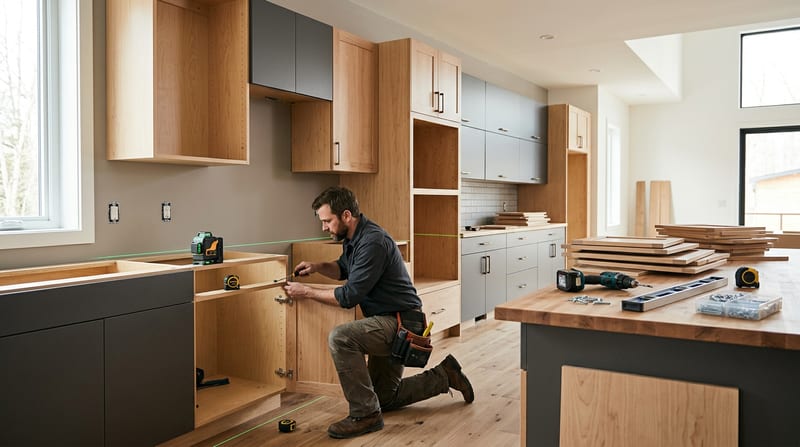
Is your kitchen remodeling bid fair?
Kitchen Cabinet Installation Cost in 2026: Per-Box Math
Chuck Thompson is a retired homebuilder and contractor who owned L.C. Thompson Construction in Jefferson City, Missouri. TheFatBook Cost Index V3 2026 (built from BLS wage and Craftsman labor data) referenced throughout this article is our proprietary dataset that powers all of our calculators and bid-fairness checkers. Full details are on the methodology tab.
Kitchen cabinet installation is a job that reads like carpentry and prices like a shopping trip. Our cost index puts a standard install at $8,301 for a typical 14-box kitchen, with most jobs landing between $7,424 and $9,246. Hold one ratio before you collect quotes. The cabinets themselves are the biggest line on the bill, and the crew that hangs them is a smaller share than most people guess. So the number that moves your budget is the tier of box you point at in the showroom, not the hours the installer books. The labor is real finish work, and it is worth understanding before you read a bid, but it is not where the money goes.
Where $8,301 Goes
| Component | Cost | Share |
|---|---|---|
| Material (the cabinets) | $3,605 | 43.4% |
| Labor (26.19 crew-hours) | $1,182 | 14.2% |
| Permit | $0 | 0% |
| Overhead | $1,962 | 23.6% |
| Contractor margin | $1,552 | 18.7% |
| Total | $8,301 | 100% |
The crew books about 26 hours across the set, better than three working days for a two-person team. A cabinet installer earns a base wage near $31.55 an hour, carried on the bid at $45.12 loaded once workers' comp and payroll taxes ride along. Those hours at that loaded rate are where the $1,182 labor line comes from, and at 14.2% it is a smaller slice than the trade-heavy reputation suggests. The $3,605 material line is the biggest single row, and it is the one that actually responds to your choices. The 23.6% overhead line is the business behind the crew: the truck, the lift, the shop time spent measuring and ordering, the warranty call when a door sags a season later. The permit row sits at zero because setting cabinets into an existing kitchen is finish work that pulls no standalone permit; a full remodel that moves plumbing or electrical is what changes that.
The Boxes Are the Lever
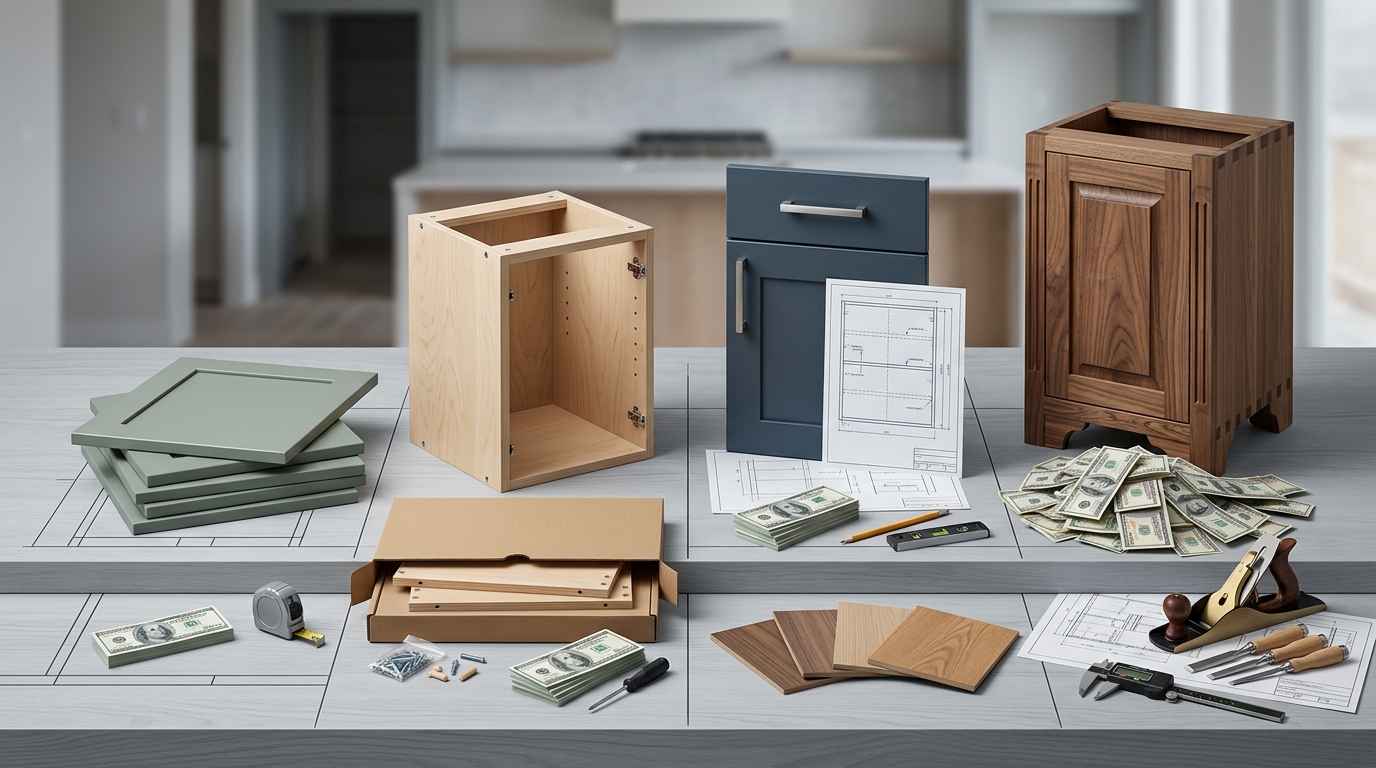
Run the labor line in your head across the tiers of cabinet you could buy. Stock, semi-custom, or custom, the crew still measures, scribes to the wall, shims the bases dead level, hangs the uppers, and fits the filler strips where the run does not land on a tidy module. The hours barely move. What moves, and moves hard, is the material line, and the tier you choose is where your budget actually lives.
The tiers are worth knowing before you read a bid. Stock cabinets, whether imported or ready-to-assemble, are the value floor: fixed sizes and finishes, on the shelf or shipping in a week or two, and the basis this $8,301 is priced on. Semi-custom lets you modify dimensions and finishes and runs several times the stock material line, with a lead time measured in weeks. Custom is unlimited design and premium construction, and it can multiply the box budget again. None of that moves the install much. It moves the $3,605 material line instead. A kitchen of imported stock boxes sits low. A custom run in furniture-grade hardwood sits far higher, on the same 26 hours of labor.
The one part of the labor that does swing is the finish detail. Hanging and leveling boxes is the fast work. Scribing cabinets to out-of-plumb walls, cutting filler strips, and running crown molding is the slow work, and crown alone can eat three to five hours of a finish carpenter's day. A kitchen with a lot of trim and a lot of out-of-square wall carries more of those hours than a clean, square galley.
Chuck's Take: Everybody shops the door style and the finish, and nobody asks about the wall behind it. I have set cabinets in houses where not one wall was plumb, and the whole day went to shims and scribe strips before a single door hung straight. The boxes are what you pay for, no argument. But when a bid comes in high on labor, it is usually the room, not the crew, padding it. Ask the installer what the walls are like before you decide the labor number is fair. Leonard "Chuck" Thompson, LC Thompson Construction Co.
What the Quote Should Actually Say

A cabinet quote worth trusting itemizes the boxes and the labor as separate lines, not a single "cabinets, installed" number. The material line should name the tier and the box count so you can weigh it against the tier you actually chose. The labor line should stand on its own, because that is the number you compare bid to bid. The bigger risk in a one-line quote is what it hides: whether any second trade is in scope. The minute the job moves a sink, adds an outlet, or relocates a circuit, a licensed plumber or electrician is on site with a minimum and a schedule of their own, and that work belongs on its own line. Ask where the boxes end and the trades begin. That is the line that turns a clean install into a project.
What Changes City to City
| Metro | Average | Range | Crew labor |
|---|---|---|---|
| Atlanta | $7,603 | $6,776 to $8,493 | $915 |
| Austin | $7,728 | $6,818 to $8,709 | $955 |
| Phoenix | $7,986 | $7,090 to $8,949 | $1,089 |
| Denver | $8,783 | $7,808 to $9,833 | $1,229 |
| Chicago | $9,367 | $8,462 to $10,342 | $1,789 |
Atlanta to Chicago is about a $1,375 spread on the same 14 boxes, and the crew explains most of it: a Chicago installer's loaded hour runs well above Atlanta's, which adds roughly $874 across the same 26 hours. The cabinets cost about the same in every market, so the boxes cannot do the spreading. What moves the number city to city is the installer's wage and the overhead of the company behind that installer, priced in the same local labor market. When the loaded hour rises, the whole bill rises with it, boxes unchanged.
Frequently Asked Questions
How much does it cost to install kitchen cabinets in 2026?
A standard 14-box kitchen runs $7,424 to $9,246 installed, with a national average near $8,301, per our index. The cabinets themselves are the biggest slice of that, and the tier you choose is the lever: imported stock or ready-to-assemble sits at the low end, semi-custom and custom climb the material line several times over on the same install hours. The labor holds around 26 crew-hours no matter which box you pick.
Why is cabinet labor a smaller share than I expected?
Because the boxes carry so much of the cost. Guides that put labor at a third or half of the bill are describing cheap cabinets, where the work is large relative to the material. On a standard install our index reads labor near 14.2% of the total, because a full set of boxes is the expensive part. The labor share climbs only when the cabinets are inexpensive or the walls are badly out of square.
Do I need a permit to install kitchen cabinets?
Usually not on its own. Setting cabinets into an existing kitchen is finish work, and our permit line for the install is $0. The permit shows up when the job crosses into a remodel that moves plumbing, adds circuits, or takes down a wall. If your scope touches those trades, ask your city what the inspection costs before you start.
How do I know if a cabinet quote is fair?
Compare the bid against the breakdown above, the boxes, the labor, and the overhead and margin, and make sure the tier on the material line matches what you chose. A flat "installed" number with no detail tells you nothing about what you are paying for. Paste the quote into our kitchen bid checker to grade it line by line before you sign.
Figures are the national project basis from TheFatBook Cost Index V3 2026 for a standard 14-cabinet kitchen installation. Metro rows reflect local wages and operating costs. Sources: Craftsman National Estimator BOM, BLS OES wages, verified permit fees.